How to Identify High-Quality Buyers That Match Your Products Using Customs Data - TradeSaya

How to Identify High-Quality Buyers That Match Your Products Using Customs Data
Finding buyers is easy. Finding the right buyers is hard. Most exporters waste time on prospects who look interested but never place meaningful orders. The difference between a mediocre lead and a high-quality buyer comes down to one word: match. A high-quality buyer is not just someone who imports your product category. It is someone whose purchasing capacity, sourcing pattern, supplier structure, and market position align with what you can profitably supply.
Customs data gives you the raw material to evaluate that match before you ever send an email. Instead of guessing whether a prospect is a good fit, you can verify their actual import activity. This article breaks down the specific criteria you should look for when using import-export data to identify high-quality buyers, and how TradeSaya turns those criteria into a practical filtering process.
Match by Product Category and HS Code
The first and most obvious filter is product match. A buyer who imports LED lighting is not automatically a good prospect if you sell high-end commercial lighting while they primarily buy low-cost residential bulbs. Customs data allows you to go deeper than the general product name.
When you search by HS code, you can see the exact product description on the shipment record. Some records include detailed specifications such as material, size, wattage, or grade. This lets you distinguish between buyers who import products similar to your exact offering and those who only operate in the same broad category.
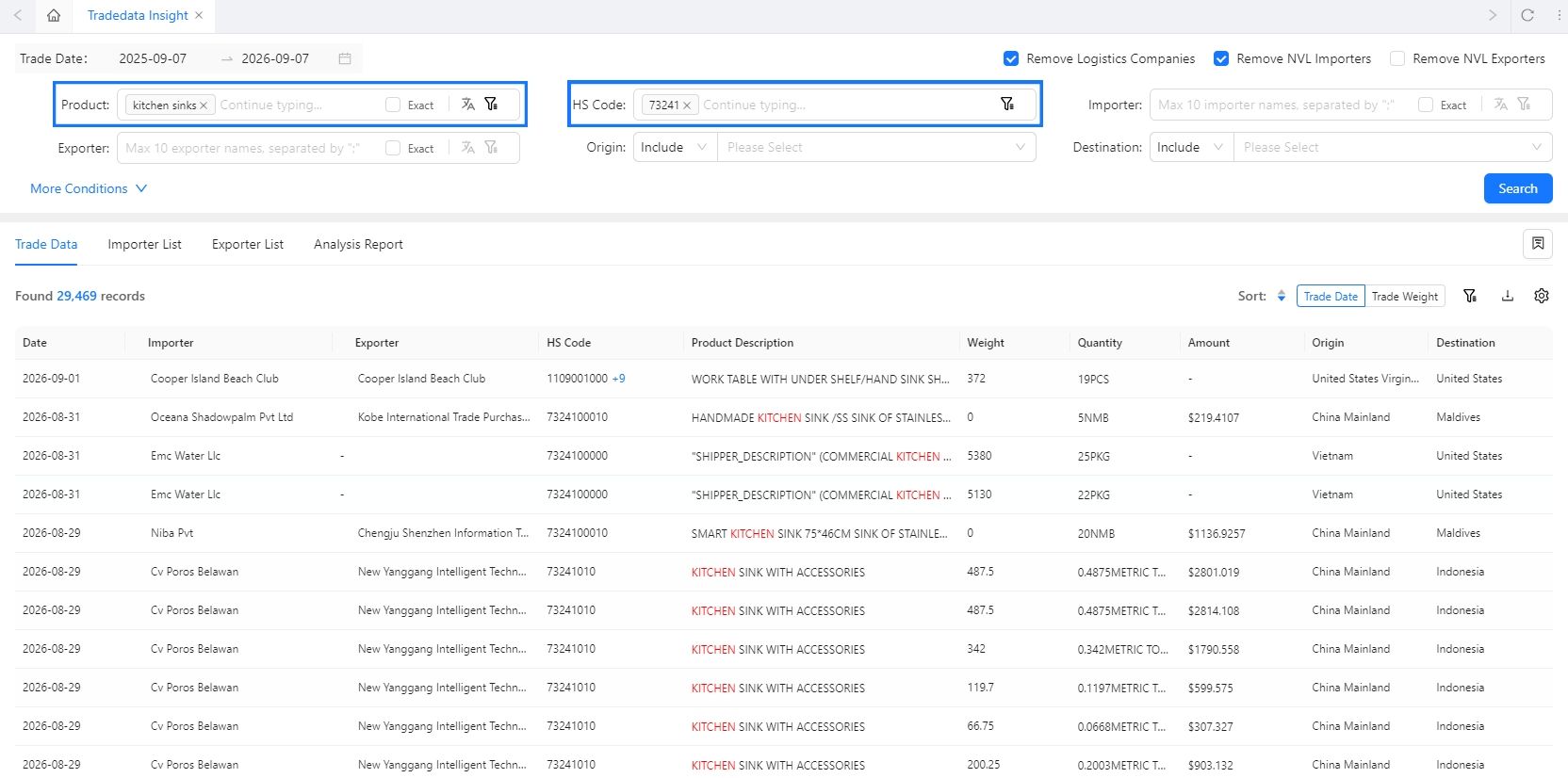
For example, if you export stainless steel kitchen sinks, you can search for HS code 7324.10 and review the product descriptions in the shipment records. You will quickly identify which importers consistently bring in high-grade stainless steel sinks versus those who mainly import low-cost alternatives. This level of product-level matching is impossible with traditional B2B directories, where companies describe themselves in generic terms.
TradeSaya allows you to search by HS code, product keyword, or supplier name, and then further filter results by shipment description. This ensures that the buyers you find are not just in the same industry—they are buying the same type of product you sell.
>>> Get a Free Demo of TradeSaya <<<
Match by Purchase Volume and Frequency
A high-quality buyer is one whose order size and ordering rhythm match your production capacity and minimum order requirements. Customs data reveals both purchase volume and purchase frequency, so you can assess whether a buyer is too small, too large, or just right for your business.
Purchase volume tells you the scale of their operations. A buyer who imports 500 units per month may be a strong prospect for a mid-sized exporter but too small for a factory with large minimum order quantities. A buyer importing 50,000 units per month may be attractive but beyond your current capacity. By analyzing volume trends in trade data, you can avoid wasting time on buyers whose size does not match your capabilities.
Purchase frequency is equally important. A buyer who imports consistently every month has stable demand and needs a reliable supplier. A buyer who imports sporadically may be project-based or just testing the market. Consistency matters because it affects your cash flow and production planning.
TradeSaya presents volume and frequency data in visual dashboards, making it easy to see whether a buyer’s purchasing pattern aligns with your operational capacity. You can set filters for minimum shipment counts or volume thresholds to quickly narrow your list to buyers who meet your qualification criteria.
Match by Supplier Structure and Loyalty
A buyer’s current supplier structure reveals a lot about their openness to new partners. Customs data shows exactly which suppliers a buyer uses, from which countries, and how those relationships have changed over time.
A buyer who has worked with the same single supplier for five years may be loyal, but also potentially locked in. Cracking that relationship takes time and a strong value proposition. A buyer who already sources from multiple suppliers in different countries demonstrates a diversified sourcing strategy. They are likely open to adding another supplier if you can offer a clear advantage.
Even more valuable is a buyer who recently switched suppliers. If their shipment history shows a decline in purchases from one supplier and an increase from another, they are actively re-evaluating their options. That is the ideal moment to introduce your company. Customs data lets you spot these transitions before they settle on a new stable supplier.
TradeSaya’s transaction graph visualizes supplier relationships, making it easy to see whether a buyer is loyal to one source or actively diversifying. This insight helps you prioritize buyers who are more likely to respond to your outreach.
Match by Market and Geographic Position
Not every buyer is a good match simply because they import your product. You also need to consider the buyer’s geographic market and how it aligns with your export strategy. A buyer who imports large volumes but operates in a highly competitive, price-sensitive market may squeeze your margins. A buyer in a niche market with less competition may be willing to pay a premium for quality.
Customs data allows you to see the buyer’s country and port of discharge, which tells you where their goods are heading. You can analyze whether their end market is attractive to you. If you are expanding into Brazil, for example, you may want to focus on importers receiving goods at Brazilian ports rather than buyers who re-export to neighboring countries.
You can also use trade data to understand the competitive landscape in the buyer’s market. Are there many suppliers exporting similar products to that country? Is the market growing or shrinking? This information helps you decide whether a particular buyer represents a sustainable, profitable opportunity or just a one-off transaction.
TradeSaya includes market trend reports and country-level analysis, so you can evaluate the attractiveness of a buyer’s geographic position alongside their individual purchasing behavior.
How TradeSaya Streamlines Buyer Qualification
Traditional lead generation produces a long list of names that require manual qualification. With TradeSaya, qualification happens inside the platform. You can filter buyers by product match, shipment frequency, volume range, supplier structure, and destination country. The result is a shortlist of high-quality buyers who are already verified by their import activity.
The platform also provides direct contact information for key decision-makers. Once you identify a high-potential buyer, you can immediately reach out with a message that references their actual import history. Instead of a generic introduction, you can say:
“I noticed your company has been importing [product] from [supplier countries] with a monthly volume of [volume]. We manufacture the same category and can offer [specific advantage]. Would you be open to comparing our product and pricing?”
That kind of message is only possible when you have customs data behind you. TradeSaya puts that data at your fingertips.
Conclusion: Match First, Contact Second
The fastest way to waste time in export sales is to chase buyers who are not a good fit. High-quality buyers are not found by luck. They are identified through systematic analysis of product match, volume match, frequency match, supplier match, and market match. Customs data provides all of these signals. TradeSaya organizes them into a workflow that leads you directly to the buyers who fit your business. Stop chasing leads. Start matching buyers.