How Exporters Can Use Global Trade Data to Build a More Targeted B2B Prospecting Strategy—- TradeSaya

B2B prospecting often starts with a familiar process:
Search for a product on Google → find relevant companies → visit their websites → look for contact information → send a cold email.
There is nothing wrong with this approach. But one important question often remains unanswered:
Are these companies actually buying your product?
A company may look like a good fit based on its website, industry, location, or company profile. But that does not necessarily mean it is actively purchasing the products you sell.
Instead of spending most of your time looking for companies that might need your products, there is another approach:
Start with real purchasing activity and use it to identify better prospects.
This is where Global Trade Data can make B2B prospecting more focused and actionable.
Why Look Beyond Company Profiles?
Traditional B2B prospecting usually starts with the company itself.
Sales teams may look at:
- What the company sells
- Its industry
- Company size
- Location
- Whether it operates internationally
- Whether its website matches the ideal customer profile
All of this information is useful.
But it mainly helps answer one question:
“Could this company be a potential customer?”
Trade data can help answer a more concrete question:“Is this company actually buying products like mine?”
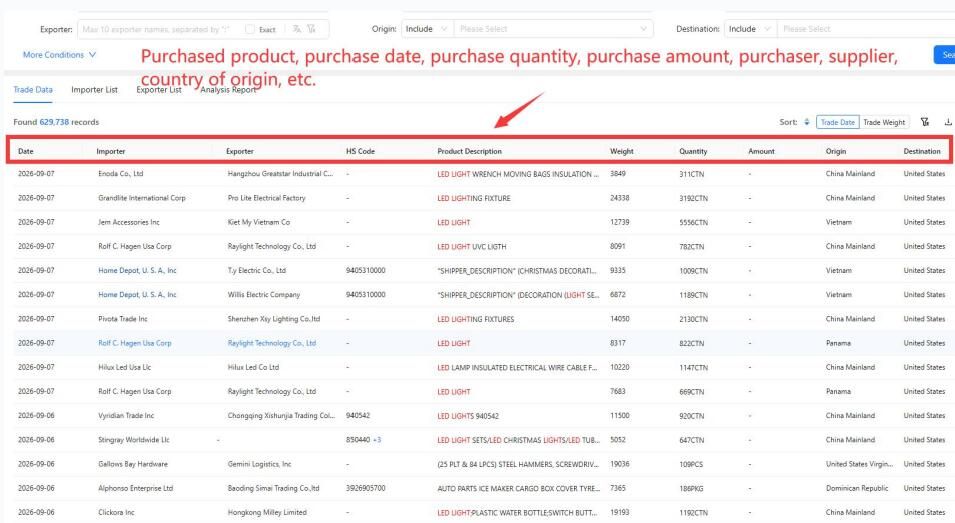
With Global Trade Data, sales teams can research purchasing activity, products, purchase frequency, shipment volumes, suppliers, and sourcing markets.
That changes the way prospects are evaluated.
Instead of asking:Which companies might need my product?
You can ask:Which companies are already buying similar products, and which buyers have purchasing patterns that match what I sell?
For B2B sales teams, those buyers are often worth prioritizing.
What If the Buyer Already Has Suppliers?
Once you identify a buyer through trade data, a common question comes up:
“They already have suppliers. Can I still develop them?”
Yes.
Having existing suppliers does not mean a buyer will never consider another one.
Supplier relationships can change for many reasons, including:
- Price
- Product quality
- Lead time
- Product innovation
- Service
- Supply stability
- Payment terms
- MOQ
- New product requirements
And developing an established buyer does not necessarily mean replacing its current suppliers.
You could become:
- An additional supplier
- A backup supplier
- A supplier for a specific product line
- A supplier for a specific market
- A supplier for a particular specification
- An alternative sourcing option
The real question is not:“Does this buyer already have suppliers?”
It is:“Do I have a good enough reason for this buyer to consider me?”
That is where trade intelligence can help you go beyond simply finding a company and start identifying potential sales opportunities.
1. Move Beyond Generic Cold Emails
If you already know that a company is purchasing products relevant to your business, your outreach should reflect that knowledge.
Many cold emails still look like this:
- We are a professional manufacturer of XXX.
- We offer high-quality products at competitive prices.
- Please let us know if you have any requirements.
The problem is simple:
Almost any supplier can send the same message.
The buyer has little reason to think:“Why are they contacting me?”
Or:“Do they actually understand my business?”
When you have access to purchasing activity, you can make your outreach much more relevant.
For example, you may know what products the buyer purchases, where it sources from, and how frequently it buys. That gives you a stronger starting point for the conversation.
For example:
We noticed that your company has been regularly sourcing XXX from China. We’d like to explore whether there could be an opportunity for us to support your current supply needs.
The goal is not simply to show the buyer what you know.
It is to make the message feel like a relevant business conversation rather than another generic sales email.
2. Give Buyers a Reason to Consider You
Finding an active buyer is only the beginning.
The next question is more important:
Why should they consider you?
If your price, quality, lead time, and service are essentially the same as those of their current suppliers, there may be little reason for the buyer to start a conversation.
Before reaching out, identify where you can create a genuine point of difference.
That could be:
- More competitive pricing
- Better product quality
- Shorter lead times
- Lower MOQs
- OEM/ODM capabilities
- More flexible customization
- More stable supply
- Specialized products or specifications
- Technology or capabilities their current suppliers do not offer
The goal is not to criticize the buyer's existing suppliers.
It is to identify a real reason to consider an alternative.
For buyers with an established supply chain, simply saying “We are a manufacturer of XXX” is rarely enough.
A stronger proposition is:“Here is something we can offer that may improve your current sourcing options.”
3. Follow the Buyer’s Purchasing Cycle
B2B purchasing is rarely random.
Some buyers purchase every month. Others purchase quarterly or adjust their sourcing based on inventory, orders, and market demand.
If you can see a buyer's historical purchasing activity, you may be able to identify patterns in its purchasing cycle.
That can make your follow-up much more effective.
Instead of repeatedly asking:
Any update?
You can align your communication with the buyer's purchasing timeline.
Before the purchasing period
Prepare relevant quotations, product information, or supply proposals in advance.
During the purchasing period
Use the buyer's previous purchasing patterns to offer relevant products, specifications, pricing, or alternatives.
Between purchasing cycles
You do not need to keep pushing for an order.
Stay relevant by sharing new products, industry developments, application ideas, or other information related to the buyer's business.
The principle is simple:
Follow the buyer's timeline, not your own sales schedule.
When the next purchasing opportunity comes up, you want your company to already be on the buyer's radar.
4. Prioritize Buyers and Focus Your Sales Effort
Once you start using Global Trade Data, you may find more potential buyers than your sales team can realistically contact.
That creates another challenge:
Who should you contact first?
Not every buyer deserves the same amount of time.
You can prioritize prospects based on factors such as:
- Purchase frequency
- Purchase volume
- Product fit
- Recency of purchasing activity
- Number of suppliers
- Sourcing markets
- Consistency of purchases
- Fit with your strongest products
For example:
High-value buyers
Frequent purchases, larger volumes, and strong product fit. These prospects deserve deeper research and more personalized outreach.
Potential buyers
Relevant purchasing activity, but lower volume or frequency. These prospects can be nurtured over time.
Lower-priority buyers
Older purchasing activity or weaker product fit. These prospects may require less manual effort.
The goal is not to contact as many companies as possible.
It is to:Spend more sales time on the buyers with stronger potential.
This is where TradeSaya Global Trade Data comes in.
TradeSaya focuses on global trade intelligence and buyer research, helping B2B companies discover and understand potential buyers through real international trade activity.

- Identify Active Buyers
Find companies that are actively importing or purchasing products relevant to your business, rather than relying only on company profiles and websites.
- Understand Purchasing Behavior
See what buyers purchase, how frequently they purchase, purchase volumes, and purchasing trends — helping you better evaluate buyer value and timing.
- Analyze Suppliers and Sourcing Markets
Understand who buyers are currently sourcing from and which countries or regions they source from, giving you a clearer view of their supply chain and potential entry points.
- Discover New Markets
Identify active markets and buyer groups based on real purchasing activity, helping exporters explore new opportunities for international expansion.
- Find Relevant Decision-Makers
Once you identify a target company, research relevant decision-makers and business contacts to make your outreach more targeted.
For B2B exporters, the goal is not simply to build a longer list of companies.
It is to understand:Who is buying, what they are buying, where they source from, how often they buy, and whether there is an opportunity for you to become their next supplier.
That is where Global Trade Data can turn customer research into a more focused B2B prospecting strategy.