How to Use Customs Data to Find Overseas Buyers: A Must-Read for B2B Sales
As digitalization continues to reshape global business, data has become an increasingly important resource for companies looking to improve their competitiveness. The same is true for international trade.
In the past, exporters mainly relied on trade shows, B2B platforms, search engines, email outreach, and other traditional channels to find overseas customers. Today, more companies are turning to real trade and customs data to identify buyers, research markets, and understand the competitive landscape.
What Is Customs Data?
Simply put, customs data refers to import and export trade information generated by customs authorities as part of international trade reporting and statistics. Depending on the country and data source, this may include import-side records, export-side records, and bill-of-lading-related information.
For example, consider a shipment exported from China to the United States under FOB terms. The Chinese seller declares the shipment to Chinese customs, which records the export information. This type of information is generally referred to as export-side or customs declaration data.
At the same time, the U.S. buyer declares the shipment to U.S. Customs, which records the corresponding import information. In some data sources, this type of information is derived from bill-of-lading records and may provide transaction fields involving the buyer and supplier.
The exact fields and level of detail vary by country and data source.
Customs data can be a powerful tool for exporters looking to expand into overseas markets. But having access to data is only the first step. The real value comes from knowing how to use it effectively.
Here are four practical ways to use customs data to find overseas buyers.
1. Search Directly by Product Keywords or HS Codes
The most straightforward approach is to search for your products directly.
For example, if you manufacture and export shoes, you can search using product keywords such as “shoes” or use the relevant HS Code.
The search results can help you identify which countries import the product, which markets have active trade activity, which companies are importing, and which suppliers those buyers are purchasing from.
When using customs data, HS Code search can be particularly useful.
In practice, you can start with the relevant 4-digit or 6-digit HS Code for your product. The first six digits of the Harmonized System are generally internationally coordinated, while individual countries may further subdivide them into 8-digit, 10-digit, or longer national tariff codes.
Therefore, when researching different overseas markets, combining product keywords with the appropriate HS Code can help you narrow down relevant buyers more accurately.
2. Search Your Competitors to Find Their Buyers
Another effective approach is to search for your competitors.
For example, suppose you are a Vietnamese exporter of LED lighting products and already know a competitor that performs well in international markets.
You can search for that company's English name in a customs data platform and examine its trade records.
This may reveal:
Which countries the competitor exports to
Which overseas buyers it works with
How much different buyers purchase
Which customers purchase more frequently
What products the competitor exports
Which markets its customers are concentrated in
This information can help you identify potential buyers based on your competitors' actual trade activity.
Instead of starting from scratch and searching for completely unknown companies, you can first study businesses that are already purchasing products similar to yours.
Of course, this does not mean every competitor's customer will become your customer. Buyers may consider price, quality, delivery time, service, certifications, supply chain stability, and many other factors when choosing suppliers.
However, from a prospecting perspective, companies with a history of purchasing relevant products are worth further research and qualification.
What If You Can't Find Your Competitor?
One thing to keep in mind is that a company's name in trade records may not exactly match the name shown on its website.
For example:
ABC LIGHTING CO., LTD.
may appear in trade records as:
ABC LIGHTING or : ABC LIGHTING INC
It may even appear under a shorter version of the company name.
If you cannot find a company using its full legal name, try removing suffixes such as CO., LTD., INC., or LIMITED, and then gradually shorten the company name.
Once you identify the correct trade records, you can continue analyzing the competitor's buyers and purchasing activity.
3. Use Reverse Search When Import Data Is Limited
One common challenge when using customs data is that not every country provides the same level of import information.
For example, some European markets do not provide the same level of detailed bill-of-lading information available in markets such as the United States. If your target markets include Germany, France, or Italy, directly searching for local importers may therefore be limited by data availability.
This is where reverse search can be useful.
When detailed import data is unavailable in your target market, you can look at export records from other trading partners and use those records to identify potential buyers in the target market.
For example, if a country has both relatively accessible import and export trade records, you may be able to identify overseas companies through another country's export data and then verify those companies through their websites, business databases, Google, LinkedIn, and other sources.
The basic idea is simple:
If you cannot see the complete import records from the buyer's market, look at the corresponding trade flow from the supplier side.
However, reverse search does not produce identical results for every country or product. Data availability, field structure, and update frequency vary across markets. For this reason, it is best to cross-check findings using multiple sources.
4. Use Similar-Buyer Research to Expand Your Prospect Pool
Another common mistake among exporters is to search only for companies that look exactly like their existing customers.
In reality, the same product can be sold through very different channels in different markets.
Take sunglasses as an example. If an exporter only targets traditional optical wholesalers and eyewear distributors, it may overlook other potential customer groups.
By analyzing buyer types in customs data, the exporter may discover that sunglasses are also purchased by fashion accessory distributors, fashion retailers, general trading companies, automotive-related channels, and other specialized retailers.
This means customs data can do more than help you find companies similar to your existing customers. It can also help you discover new types of potential buyers.
Once you identify a new buyer type through trade data, you can build a buyer profile and use Google, LinkedIn, Google Maps, industry websites, and social media to find more companies with similar characteristics.
In other words, customs data can be the starting point for building a buyer profile, not the endpoint.
For example, if trade data shows that a particular type of importer purchases your products frequently, you can study the common characteristics of these companies, including their industry, company size, business model, sales channels, and target markets.
You can then use these characteristics to find more similar prospects.
This is how the value of customs data goes beyond simply providing a list of buyers. It can help exporters build more precise buyer profiles and continuously expand their target customer pool.
Finding the Buyer Is Only the First Step: Find the Right Contact
Regardless of which customs data method you use, B2B sales ultimately comes down to one critical question:
How do you reach the person who can actually influence the purchasing decision?
Knowing the name of an overseas company does not automatically lead to an order. Sales teams still need to identify the purchasing manager, owner, CEO, supply chain manager, or other relevant decision-maker and find the right way to contact them.
This is also one of the reasons why some companies fail to get the expected results from customs data.
Some customs data platforms can provide buyer names but do not provide the key contacts behind those companies. Salespeople then have to search Google, LinkedIn, company websites, and other sources one by one to identify the right people and verify their contact details.
For sales teams developing a large number of overseas prospects, this process can be extremely time-consuming.
TradeSaya's customs data platform helps take this process one step further by enabling sales teams to dig deeper into key contacts at target companies.
You can identify relevant decision-makers such as business owners, purchasing managers, and CEOs, along with available phone numbers, email addresses, and social media accounts.
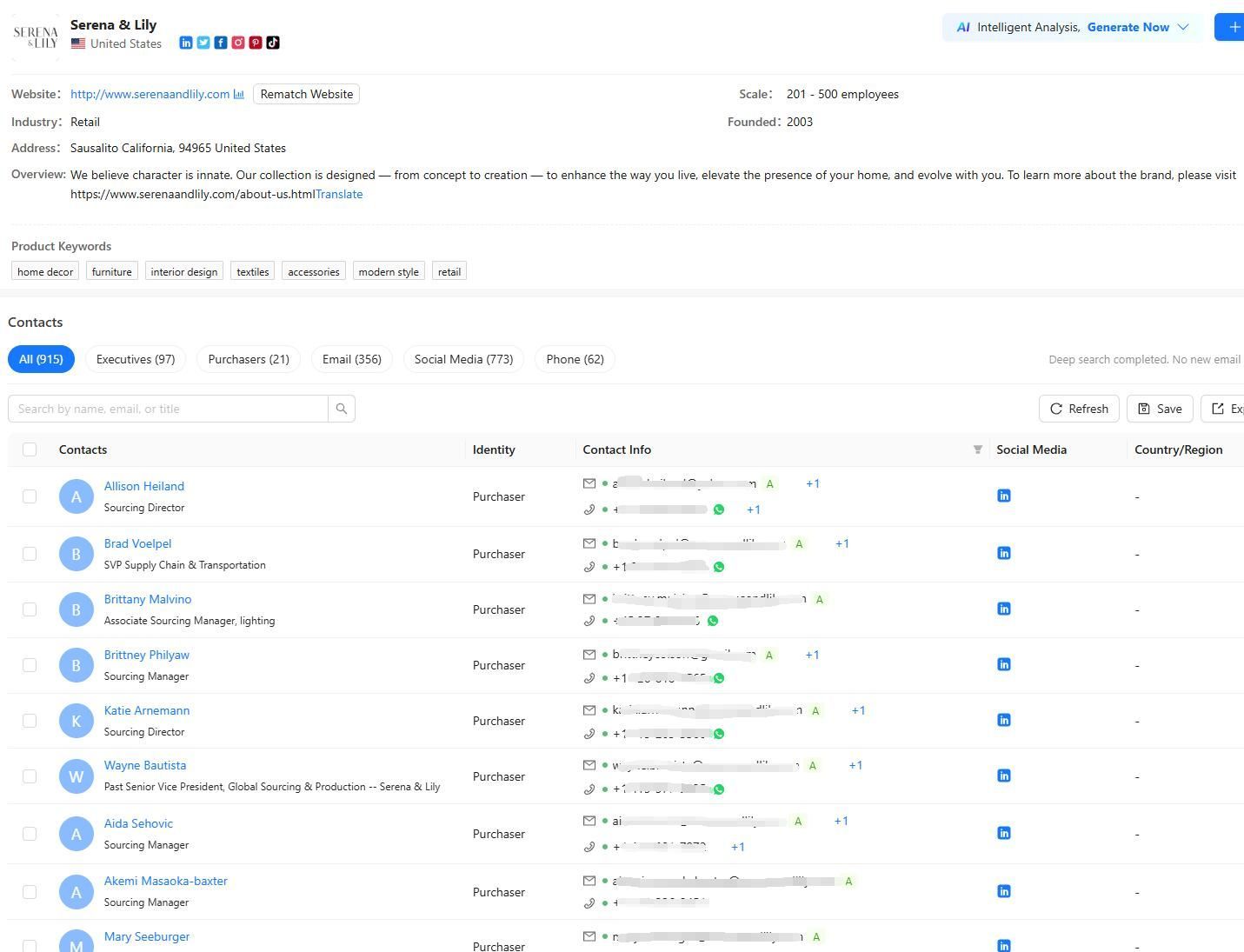
Instead of stopping at “find the buyer,” you can move to “find the right person.”
With multiple contact channels available, sales teams can proactively reach out to potential buyers, better understand their needs, and create more opportunities for business cooperation.