How to Find Furniture Importers in the U.S. Using Customs Data-TradeSaya

The United States is one of the world’s most important furniture import markets.
According to U.S. trade data compiled by UN Comtrade, the United States imported approximately $51.86 billion worth of furniture, seating, and related products in 2025 .
Its substantial import demand, diverse product categories, and well-established network of importers, distributors, retailers, and furniture brands make the United States a key market for global furniture exporters.
Which countries supply the most furniture to the United States? Which product categories have the highest import value? More importantly, how can furniture exporters identify U.S. buyers with genuine purchasing demand?
Where Does the United States Import Furniture From?
In 2025, the leading suppliers of furniture and related products to the United States included Vietnam, Mexico, China, Canada, Italy, and Malaysia.
Vietnam was the largest supplier, accounting for approximately $14.42 billion, or 27.8% of U.S. imports in these product categories.
Mexico ranked second, supplying approximately $10.02 billion, followed by China at approximately $9.75 billion. Together, Vietnam, Mexico, and China accounted for around 65.9% of the market.
Other important supplier countries included:
- Canada, with approximately $3.71 billion in exports to the United States
- Italy, with approximately $1.84 billion
- Malaysia, with approximately $1.73 billion
- Indonesia, with approximately $1.18 billion
- Thailand, with approximately $1.11 billion
- Cambodia, with approximately $880 million
This diverse sourcing structure shows that U.S. buyers regularly purchase furniture from multiple international markets.
Furniture exporters with competitive products, pricing, design capabilities, delivery performance, or customization services therefore still have significant opportunities to develop potential buyers in the United States.
What Types of Furniture Does the United States Import?
U.S. furniture imports cover a wide range of product categories, including upholstered seating, wooden furniture, metal furniture, bedroom furniture, kitchen furniture, office furniture, and furniture parts.
In 2025, parts of seats under HS 940199 represented the largest furniture-related category, with an import value of approximately $10.01 billion.
Other major categories included:
- Upholstered seats with wooden frames: approximately $7.36 billion
- Other wooden furniture: approximately $6.43 billion
- Other metal furniture: approximately $5.34 billion
- Wooden bedroom furniture: approximately $3.79 billion
- Wooden kitchen furniture: approximately $2.74 billion
- Other furniture parts: approximately $2.27 billion
- Other seats with metal frames: approximately $2.00 billion
- Upholstered seats with metal frames: approximately $1.75 billion
- Metal furniture for offices: approximately $1.22 billion
These figures show substantial U.S. import demand across seating, wooden furniture, metal furniture, bedroom furniture, and kitchen furniture.
However, market size only confirms that demand exists.
For furniture exporters, the more important question is:How can you identify U.S. companies that are actively purchasing your products, have suitable buying capacity, and are worth prioritizing?
With TradeSaya, furniture exporters can start with actual trade activity, identify active U.S. importers, and evaluate their purchasing demand, buying capacity, supplier relationships, and potential difficulty of conversion.
1. Find Active Furniture Importers by Product
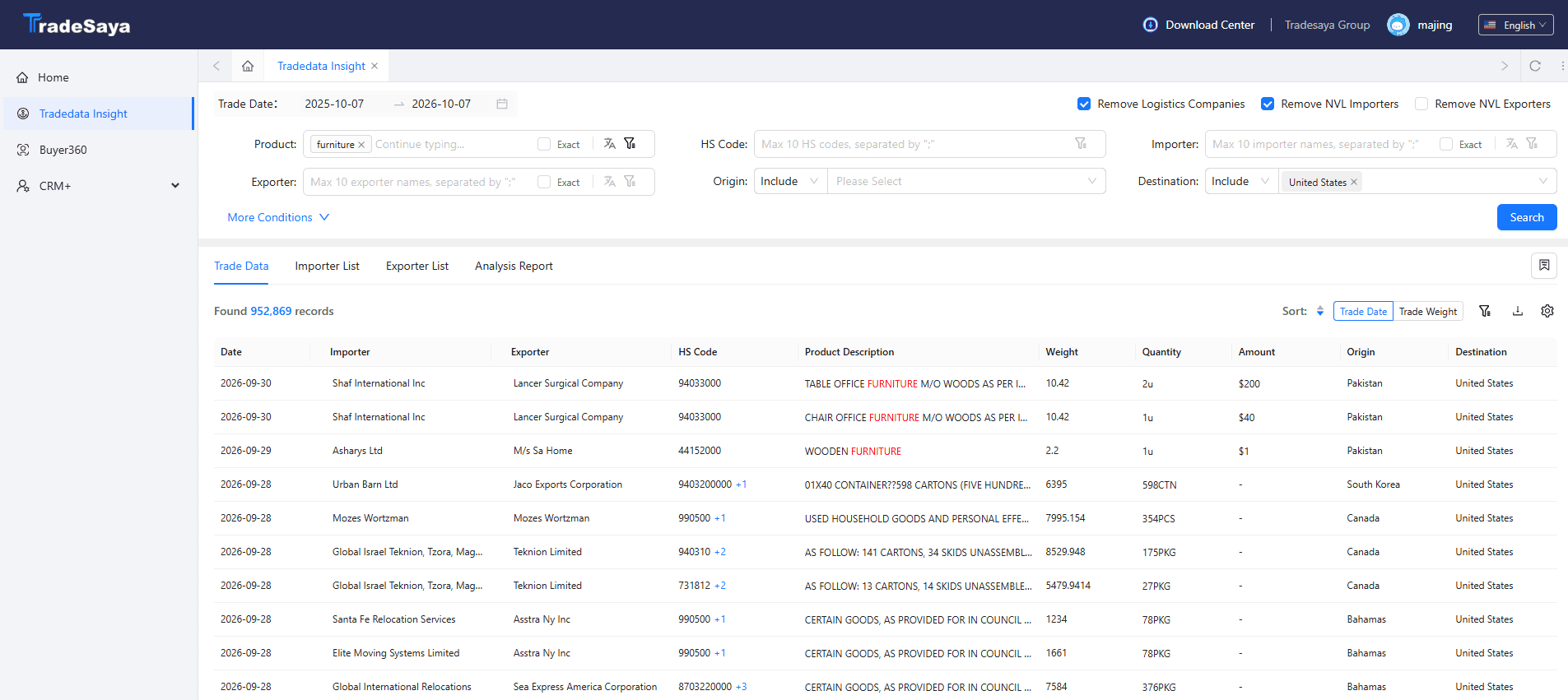
The first step is to enter a specific product keyword in TradeSaya and set the United States as the destination market.
Search results can help sales teams identify U.S. companies that have actually imported relevant products.
2. Evaluate Demand and Buying Capacity Through Purchase History
Finding potential importers does not mean that every company should immediately be treated as a high-quality prospect.
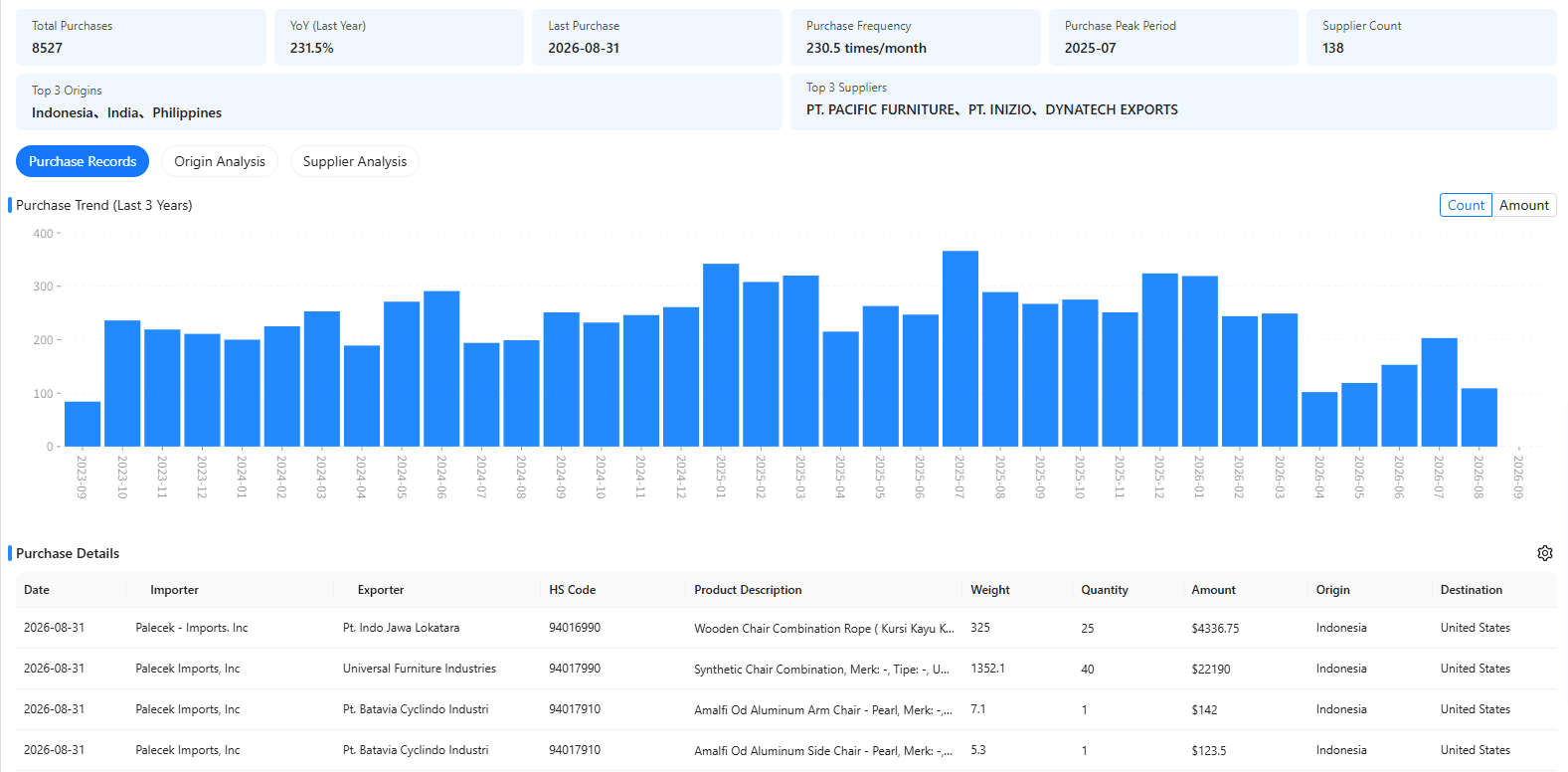
The next step is to examine each buyer’s historical purchasing activity and determine whether its demand and purchasing capacity match your business.
Important factors to review include:
- Date of the most recent purchase
- Number of purchases during the past year
- Consistency of purchasing activity
- Average shipment size
- Total purchasing volume
- Changes in purchasing volume
- Product descriptions
- Main product categories
- Typical reorder cycle
- Whether the buyer’s order size matches your production capacity
3. Analyze Supplier Relationships and Existing Competitors
TradeSaya can also help furniture exporters understand which suppliers a buyer is currently working with.
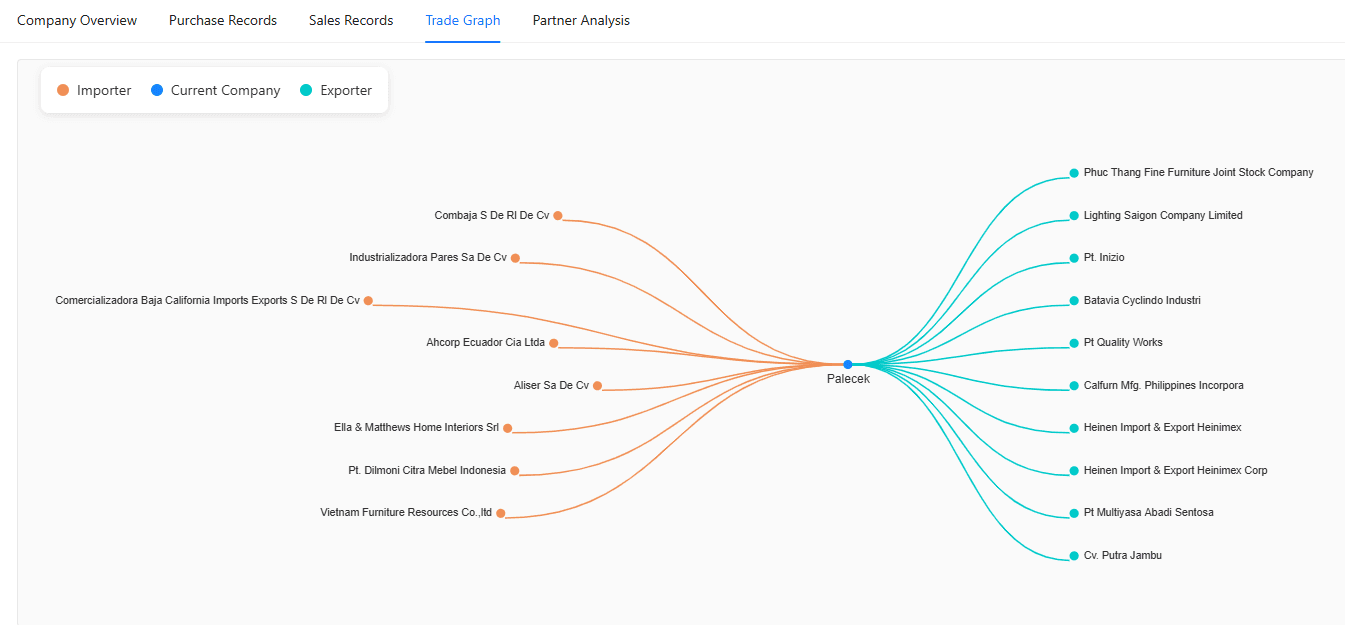
This allows the sales team to research existing competitors and compare:
- Differences between your products and those of current suppliers
- Materials and manufacturing processes
- Product design and market suitability
- Pricing competitiveness
- Minimum order quantity flexibility
- Delivery reliability
- Customization capabilities
- Packaging for retail or e-commerce channels
- Relevant certifications and product testing
- Products that existing suppliers may not currently offer
A clear understanding of existing supplier relationships helps exporters develop stronger positioning, more relevant offers, and more convincing sales messages.
4. Monitor Supply Chain Changes to Assess Sales Difficulty
The stability of a buyer’s supplier network can indicate how difficult the account may be to develop.
If an importer has worked with the same supplier for several years and its purchasing frequency and volume remain stable, the relationship may already be well established.
Such a buyer may still be worth contacting, but winning its business could require a stronger point of differentiation and a longer sales cycle.
If an importer purchases from several suppliers, it may be more willing to select different partners based on product category, price, lead time, design, or supply capacity.
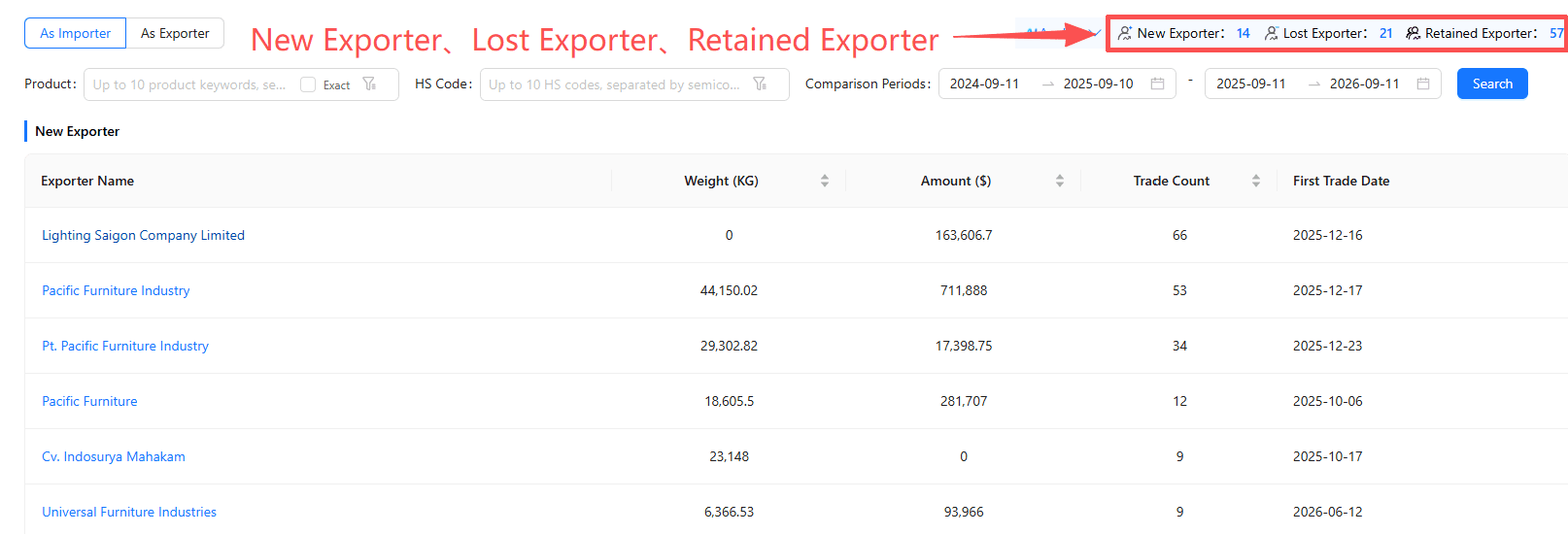
Using these criteria, furniture exporters can prioritize buyers more effectively and focus their sales resources on the accounts with the greatest potential.
5. Reach the People Who Make Purchasing Decisions
Identifying a qualified importer is only the first step.
If a sales representative can only reach a general company inbox, customer service employee, or someone unrelated to purchasing, even a highly qualified account may produce little response.
To improve sales efficiency, exporters need to identify the people directly involved in supplier evaluation and purchasing decisions, such as:
- Purchasing Manager
- Procurement Manager
- Sourcing Manager
- Supply Chain Manager
- Owner
- Founder
- President
- CEO
- Director
In addition to identifying furniture importers with real trade activity, TradeSaya can provide available decision-maker information, including:
- Name
- Work email
- Phone number
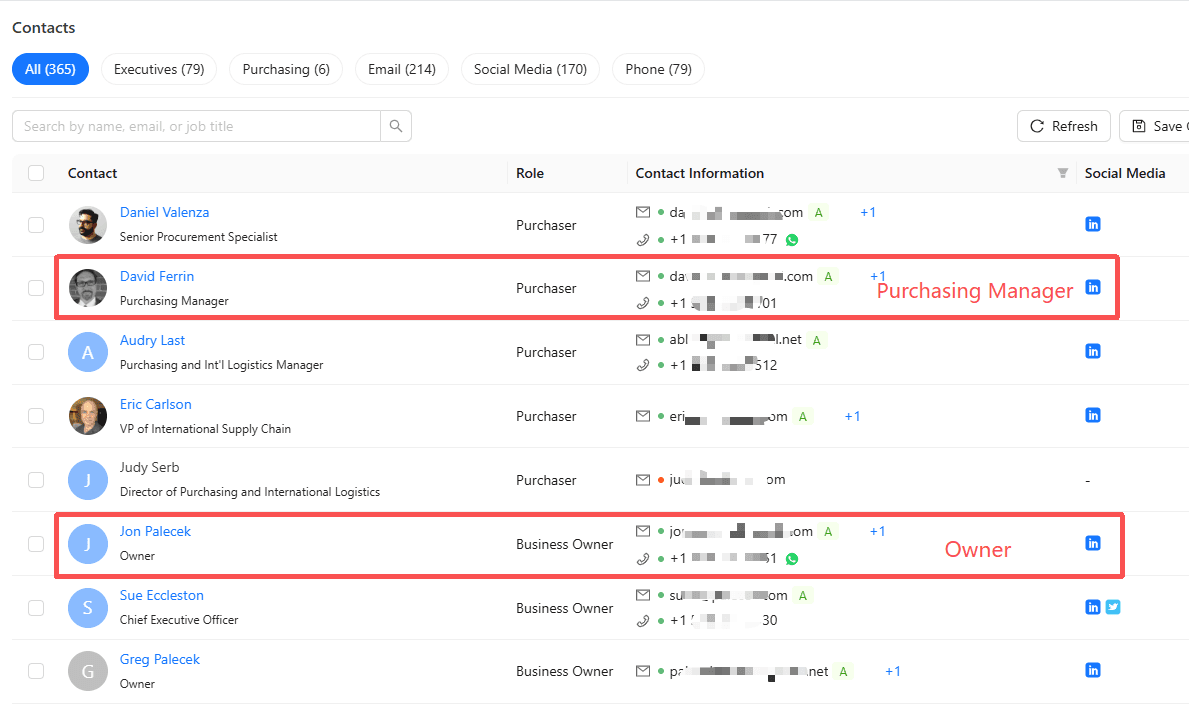
This helps sales teams connect directly with purchasing professionals, business owners, and senior executives instead of spending hours searching across multiple websites and social platforms.
Direct access to relevant decision-makers can also move product, pricing, and partnership discussions forward more efficiently.
6. Personalize Outreach for Each Decision-Maker
Once the right contact has been identified, the outreach message should be adapted to that person’s responsibilities.
Different decision-makers care about different aspects of a potential supplier relationship.
Contacting a Purchasing Manager
Purchasing professionals are generally interested in:
- Product pricing
- Minimum order quantities
- Payment terms
- Lead times
- Product specifications
- Quality consistency
- Production capacity
The message should clearly explain the product match and the proposed commercial terms.
Contacting a Supply Chain Manager
Supply chain professionals are more likely to focus on:
- Delivery reliability
- Production lead times
- Logistics arrangements
- Packaging efficiency
- Inventory and replenishment
- Supply chain risks
- Backup supply options
The outreach message can emphasize stable supply, reliable delivery, flexible production planning, or risk reduction.
Contacting an Owner or Senior Executive
Business owners and senior executives are usually more interested in the overall commercial value of a potential partnership, including:
- Whether the supplier can reduce sourcing costs
- Whether it can improve supply stability
- Whether it can expand the company’s existing product range
- Whether it can support business growth
- Whether it can offer a reliable long-term partnership
Messages to senior executives should be concise and focused on commercial value rather than overloaded with technical product details.
By understanding a buyer’s purchasing activity and adapting the message to the recipient’s responsibilities, sales teams can make their outreach more relevant and improve the likelihood of receiving a response.
Conclusion
The United States imports tens of billions of dollars’ worth of furniture, seating, and related products every year, making it an important market for furniture exporters.
Effective buyer development, however, is not about collecting the largest possible company list.
It is about identifying buyers with genuine purchasing demand, suitable buying capacity, accessible supplier opportunities, and reachable decision-makers.
TradeSaya brings together global trade data, buyer purchase history, supplier relationships, supply chain changes, decision-maker contact information, and sales follow-up tools in one workflow.
It helps furniture exporters:
- Identify active importers
- Evaluate purchasing demand and buying capacity
- Analyze existing competitors
- Detect changes in supplier relationships
- Assess the difficulty of developing each account
- Reach purchasing professionals, business owners, and senior executives
- Create more relevant and targeted sales outreach
Want to know which U.S. importers are currently purchasing your furniture products?